
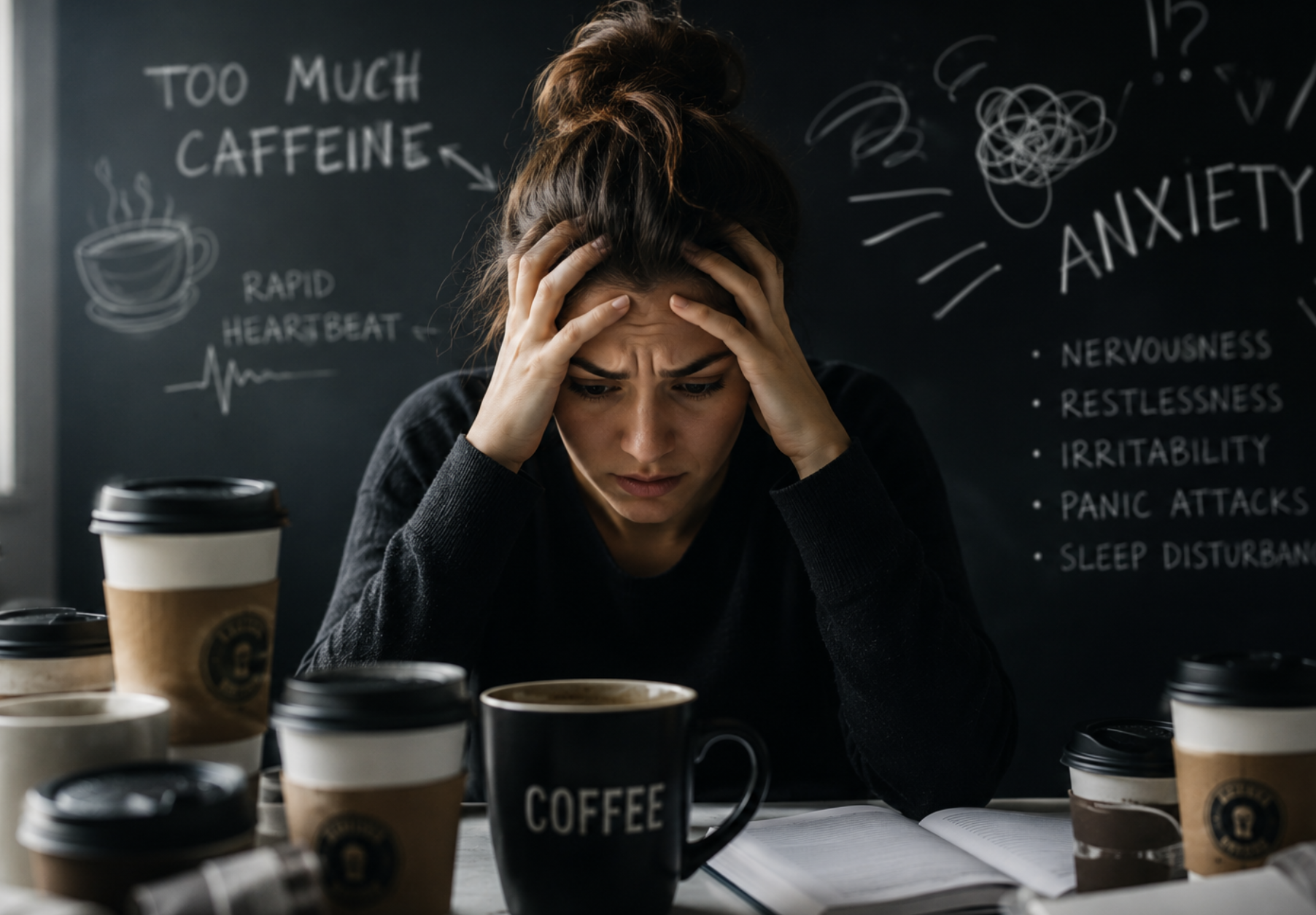
Caffeine is the most widely consumed psychoactive substance on the planet. It is in the coffee most people drink before they can think straight, the energy drinks marketed as productivity tools, the pre-workout supplements taken before a gym session, and the afternoon tea that feels harmless enough. Globally, more than 85 percent of the population consumes caffeine in some form daily.
It is also a stimulant drug — one with a well-documented relationship to anxiety that most people either do not know about or choose not to examine too closely.
That relationship is now under sharper scientific focus than ever. A 2026 systematic review published in the journal Stress and Health concluded that the findings across the research literature are predominantly in favor of caffeine being associated with increased anxiety symptoms. A meta-analysis published in Frontiers in Psychology found a strong association between caffeine consumption and anxiety risk, particularly at higher doses. And a comprehensive review published in Current Nutrition Reports in 2025 examined the longitudinal effects of lifetime caffeine consumption on anxiety, stress, and depression — finding that the relationship between the two is neither simple nor consistently benign.
Here is what the science actually says about why caffeine and anxiety are so closely linked — and why it affects some people far more severely than others.
How Caffeine Works in the Brain
To understand the caffeine-anxiety connection, it helps to understand the mechanism through which caffeine exerts its effects.
Throughout the day, as the brain burns energy, a neurochemical called adenosine accumulates. Adenosine is the brain’s natural braking system — as it builds up, it binds to adenosine receptors and progressively promotes feelings of drowsiness and mental deceleration. It is essentially the biological signal that the brain needs rest.
Caffeine works by blocking adenosine receptors. It does not create energy or alertness on its own — it prevents the brain from receiving its own fatigue signals. When adenosine is blocked, neurons fire more rapidly, arousal increases, and blood pressure rises slightly. The result is the familiar state of heightened alertness most people associate with a morning cup of coffee.
But the stimulation does not stop there. Caffeine also activates the hypothalamic-pituitary-adrenal axis — the hormonal system that governs the body’s stress response — triggering the release of cortisol and adrenaline. These are the same stress hormones released during fear, danger, and acute psychological stress. When caffeine raises their levels, it creates a physiological state that is functionally indistinguishable from low-grade anxiety: elevated heart rate, increased blood pressure, faster breathing, heightened muscle tension, and a nervous system primed for reaction.
For some people, this state feels like energy and focus. For others — and particularly for those already managing anxiety — it tips the physiological balance toward agitation, worry, and dread.
The Dose Relationship
Caffeine’s relationship to anxiety is strongly dose-dependent, and the doses many people consume daily are higher than they often realize.
Research published in Frontiers in Nutrition found that the association between caffeine and anxiety was most pronounced at high doses — defined as 400 milligrams or more per day. That figure is significant because 400 milligrams is the upper threshold commonly cited as the daily safe limit for healthy adults. A standard 16-ounce drip coffee can contain anywhere from 200 to 350 milligrams of caffeine. A single large energy drink often contains between 150 and 300 milligrams. An espresso-based drink, a pre-workout supplement, and an afternoon soda can stack up faster than most people account for.
At lower doses, caffeine’s anxiogenic effects are measurable but more modest. The problem is that cumulative daily intake, across all sources, frequently exceeds what people estimate. And the effects compound when caffeine is consumed during periods of psychological stress — research has shown that caffeine’s elevation of cortisol is most pronounced when consumed on an empty stomach or during high-stress periods, precisely the contexts in which many people reach for it most readily.
Caffeine, Sleep, and the Anxiety Feedback Loop
One of the most underappreciated dimensions of the caffeine-anxiety relationship is the role of sleep disruption.
Caffeine’s half-life in the body — the time required for concentration to fall by half — averages between five and six hours in healthy adults, though it varies considerably. This means that a 3:00 PM coffee at 300 milligrams still has roughly 150 milligrams active in the system at 9:00 PM. Even when caffeine no longer feels stimulating, it continues to suppress adenosine signaling and can meaningfully reduce sleep quality, shorten deep sleep stages, and fragment nighttime rest.
Sleep deprivation and anxiety are bidirectionally linked. Poor sleep elevates cortisol the following day, lowers the threshold for emotional reactivity, and impairs the prefrontal cortex’s ability to regulate stress responses. An individual who relies on caffeine to compensate for poor sleep — and whose poor sleep is itself partly a product of prior caffeine consumption — is caught in a cycle that quietly but reliably amplifies baseline anxiety over time.
Research published in 2026 in the journal Stress and Health specifically flagged this feedback loop, noting that caffeine-induced sleep disruption may constitute one of the primary pathways through which habitual caffeine use contributes to anxiety disorders, rather than the acute stimulant effect alone.
Why Some People Are Far More Sensitive Than Others
One of the most significant developments in caffeine research over the past several years is the growing understanding of individual genetic variation in caffeine sensitivity — and its direct implications for anxiety.
Two genes in particular are highly relevant.
The first is CYP1A2, which encodes the liver enzyme primarily responsible for metabolizing caffeine. People with a slow-metabolizer variant of CYP1A2 break down caffeine at a significantly reduced rate — meaning the same dose that clears a fast metabolizer’s system in four to five hours may linger for eight to twelve hours or more in a slow metabolizer. For slow metabolizers, standard daily caffeine consumption can produce sustained neurological stimulation that mimics chronic low-grade anxiety, even when intake feels moderate.
The second is ADORA2A, which encodes the adenosine A2A receptor — the primary receptor caffeine blocks. A well-studied genetic variant in ADORA2A is associated with markedly heightened anxiety responses to caffeine, even at low doses. Research has found that individuals carrying the T allele of the rs5751876 polymorphism experience pronounced nervousness, agitation, and anxiety after caffeine intake that other individuals do not — and that this sensitivity is a stable, inherited trait rather than a modifiable one. Studies have confirmed that oral caffeine precipitates panic attacks in a subset of individuals with panic disorder and generalized anxiety disorder, with the ADORA2A variant implicated as a contributing factor.
The practical implication is significant: the relationship between caffeine and anxiety is not uniform across the population, and an intake level that is entirely manageable for one person may be genuinely destabilizing for another — not due to any psychological weakness, but due to genetic architecture that determines how the brain processes and responds to the molecule.
Energy Drinks: A Compounding Risk
The conversation around caffeine and anxiety has intensified in recent years in large part because of the energy drink industry. Energy drinks now represent a primary caffeine source for adolescents and young adults — a population with developing neural systems and higher baseline rates of anxiety disorders.
Unlike coffee or tea, energy drinks often combine caffeine with additional stimulants — taurine, guarana, ginseng, high-dose B vitamins — in ways that amplify the overall physiological effect beyond what the caffeine content alone would predict. The AMA has published position statements citing energy drinks’ association with elevated risks of cardiovascular events, anxiety, and insomnia, particularly in younger consumers. Research has found that high-volume energy drink consumers are more likely to self-report severe anxiety symptoms, and that the combined stimulant load in these products creates a physiological response that exceeds what many individuals can metabolize comfortably.
What the Research Recommends
The scientific literature does not recommend eliminating caffeine across the board. For many individuals, moderate consumption within sensible limits has demonstrable cognitive benefits and does not produce clinically significant anxiety. The picture becomes more complicated — and more worth examining — for people who are already managing anxiety disorders, who have a family history of anxiety or panic disorder, who are poor sleepers, or who are unknowingly high consumers across multiple caffeine sources throughout the day.
For those individuals, several evidence-based considerations apply. Timing matters substantially — consuming caffeine primarily in the morning, and cutting off intake by early afternoon, reduces sleep disruption and cortisol accumulation during waking hours. Total daily intake matters — tracking all caffeine sources, not just coffee, often reveals that actual consumption significantly exceeds perceived consumption. And tolerance matters less than commonly assumed — habitual use may reduce the subjective sense of stimulation, but research has shown that caffeine continues to suppress adenosine signaling and elevate cortisol even when it no longer feels alerting, meaning tolerance to the anxiogenic effect is incomplete even when tolerance to the energizing effect is well-established.
For individuals with a known sensitivity — whether diagnosed, self-reported, or suspected — gradually reducing intake under the guidance of a healthcare provider, rather than abrupt cessation, is generally recommended to avoid the withdrawal effects of headache, fatigue, and rebound anxiety that accompany sudden discontinuation.
The Bigger Picture
Caffeine is not inherently dangerous, and framing it that way would misrepresent the evidence. What the research does make increasingly clear is that for a meaningful proportion of the population, daily caffeine habits are operating as an unrecognized variable in their anxiety experience — one that is accessible, modifiable, and worth paying attention to.
The question is not whether caffeine is good or bad in the abstract. It is whether a given individual’s particular pattern of use, at their particular dose, consumed at their particular times, across their particular genetic background, is quietly raising the floor of their anxiety rather than just raising their alertness.
For many people, that is a question worth asking.
Contact us online or call 844-525-2899 to speak with a member of our team today.
This article is intended for informational purposes only and does not constitute medical advice. Individuals managing anxiety or related conditions should consult a qualified healthcare provider before making changes to their dietary habits.